FirmoGraphs keeps its clients up to date on capital plans of interest for long-term business development. We help our customers use this information to gain a competitive advantage and improve proactive conversations with their clients. We recently processed the latest capital spending plan by the State of Florida Department of Environment Protection. Here are our observations.
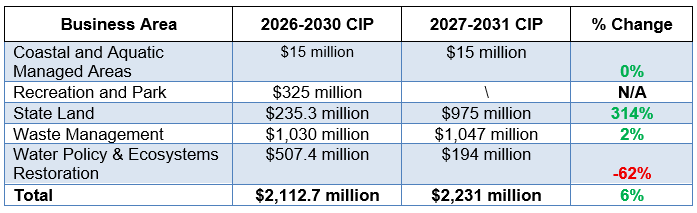
The Florida Department of Environmental Protection’s 2027–2031 Capital Improvement Plan (CIP) totals $2.231 billion across 14 project line items, reflecting a 6% increase compared to the $2.112.7 billion and 17 project line items in the 2026–2030 CIP. Although overall funding rises, the reduction in line items indicates a strategic consolidation into fewer, higher-value initiatives. Overall, the 2027–2031 CIP represents a focused, high-impact investment strategy aligned with environmental stewardship and statewide conservation goals. The table below breaks down Florida DEP’s planned capital spending by business area for its last two CIPs.
*Numbers are Rounded
Top 3 Projects by Value (2027-2031 CIP)
- Petroleum Tanks Cleanup – $975 million, under the Waste Management business area. This is a large, statewide program aimed at remediating contamination from petroleum storage tanks, addressing soil and groundwater impacts, and ensuring sites meet environmental and public health standards. Its size makes it the single largest project in the CIP.
- Florida Forever Land Acquisition – $900 million, from the State Lands business area. The project is a major land conservation and acquisition initiative, supporting the protection of environmentally significant lands, water resources, and habitats. This project is a key driver of the large increase in State Lands funding in the 2027–2031 plan.
- Land Acquisition – FCT – $75 million, under the State Land business area. The project is another substantial land acquisition program, complementing Florida Forever. It supports the state’s long-term strategy of preserving critical conservation lands and expanding protected areas.
State of Florida DEP's Capital Plan Approval and Governance
- The Florida Department of Environmental Protection’s Bureau of Budget and Planning coordinates the agency’s budget, including the annual Legislative Budget Request (LBR) and Long-Range Program Plan, and serves as DEP’s liaison to the Governor and Legislature, which is the core of how its capital plans move into the statewide budget process.
- The capital plans are not final until approved and funded through Florida’s annual state budget (the General Appropriations Act) passed by the Legislature
- For governance and transparency, DEP’s budget materials (including LBRs that embed capital requests) are publicly posted on the Florida Fiscal Portal, which consolidates agency budget documents, Governor’s recommendations, and House and Senate appropriations bills.
Sources: DEP Budget & Planning: https://floridadep.gov/adm/budget-planning, Florida State Senate Appropriation: https://www.flsenate.gov/Session/Appropriations/2026, Florida Fiscal Portal: https://floridafiscalportal.state.fl.us/?utm_source=
Spending Trends and Insights
Total planned capital spending for the Florida Department of Environmental Protection increases to 6% with fewer, larger line items. Funding for State Lands grows sharply from about $235 million to $975 million, driven by major land acquisition programs, while Waste Management rises slightly from about $1.03 billion to $1.047 billion, remaining the largest program area. By contrast, Recreation and Park drops from $325 million to $0, and Water Policy & Ecosystems Restoration declines from about $507 million to $194 million, indicating a strategic shift toward land conservation and long-term remediation over park development and ecosystem restoration projects in this planning window.State of Florida DEP History
Florida’s modern environmental agency evolved in stages: in the late 1960s and 1970s the state created the Department of Air and Water Pollution Control, later reorganized as the Department of Environmental Regulation (DER), to consolidate responsibilities for air and water quality and major land-management decisions. In 1993, the Florida Environmental Reorganization Act merged the Department of Environmental Regulation and the Department of Natural Resources to form today’s Florida Department of Environmental Protection (DEP), now the state’s lead agency for environmental management and stewardship.
Sources: General History Overview: https://en.wikipedia.org/wiki/Florida_Department_of_Environmental_Protection, About DEP: – https://floridadep.gov/sec/sec/content/about-dep
Fun Facts about State of Florida DEP
- Florida has one of the largest state park systems in the United States, and DEP oversees 175 state parks, trails, and historic sites, covering more than 800,000 acres and 100 miles of beaches.
- DEP manages the iconic Florida Springs, including world-famous freshwater gems like Ichetucknee Springs and Wakulla Springs, some of the largest and clearest springs on Earth.
- The agency plays a major role in protecting more than 1,350 miles of coastline, giving Florida the longest coastline in the contiguous United States.
- DEP administers the Florida Forever program, one of the nation’s most successful land conservation initiatives, helping protect millions of acres of environmentally significant lands since its launch.
How FirmoGraphs Can Help
FirmoGraphs curates data about U.S. public sector markets, including transportation improvement programs, regulatory developments, and other critical information. We help our customers use this information to gain a competitive advantage and improve proactive conversations with their clients. We’d be glad to meet with you and help your company sort through the wealth of information in improvement programs and other publicly available documents. Feel free to request a meeting and review the data live on our Business Intelligence platform.